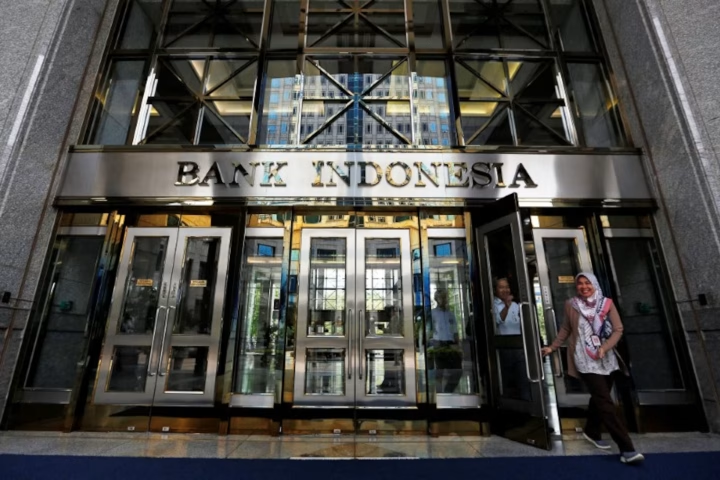
The Meaning of the 2026 Global Banking Reset
The global banking system is undergoing a structural reset rather than a cyclical adjustment. By 2026, the foundations of banking—money, trust, and regulation—are being redefined simultaneously.
This reset reflects deeper changes in technology, geopolitics, and economic governance that are reshaping how value moves across borders.
Stablecoins Move From the Margins to the Core
Why Stablecoins Matter to Global Banking
Stablecoins are digital currencies designed to maintain a stable value, typically pegged to fiat currencies. Their reliability has positioned them as a bridge between traditional finance and digital payments.
By 2026, stablecoins are no longer experimental tools but functional components of international finance.
Cross-Border Payments and Liquidity
Traditional cross-border payments remain slow and expensive. Stablecoins enable near-instant settlement and lower transaction costs.
Global banks increasingly use stablecoins to improve liquidity management and settlement efficiency.
Regulated Issuance and Institutional Adoption
Unlike earlier crypto models, stablecoins in 2026 are increasingly issued under regulatory oversight.
This has encouraged adoption by banks, payment networks, and multinational corporations.
Agentic AI Reshapes Banking Operations
From Automation to Autonomous Decision-Making
Agentic AI refers to systems capable of making decisions, executing actions, and adapting to new information with limited human input.
In banking, these systems now support trading, risk management, compliance, and customer service.
Risk Assessment and Credit Decisions
Agentic systems analyze real-time market data, borrower behavior, and macroeconomic indicators.
This enables faster, more precise credit decisions while reducing operational risk.
Operational Efficiency and Cost Reduction
- Real-time monitoring: Continuous assessment of transactions and exposures.
- Process optimization: Reduced manual intervention.
- Scalability: Support for global operations without linear cost growth.
The Convergence of Global Banking Regulation
Why Regulatory Alignment Is Accelerating
Financial crises, digital assets, and cross-border crime have highlighted the limits of fragmented regulation.
Regulators increasingly collaborate to align standards across regions.
Common Themes in Regulatory Frameworks
Despite regional differences, regulators now share common priorities: financial stability, consumer protection, and transparency.
Capital adequacy, digital asset oversight, and operational resilience are central concerns.
Regional Perspectives on the Banking Reset
North America
Banks focus on integrating stablecoins into payment systems while ensuring strict compliance.
Supervisory authorities emphasize resilience, data governance, and systemic risk management.
Europe
European banking prioritizes regulatory harmonization and digital finance frameworks.
Cross-border coordination remains a defining feature of the region’s approach.
Asia-Pacific
Rapid innovation characterizes banking in Asia-Pacific markets.
Digital currencies, real-time payments, and platform-based banking models are widely adopted.
Central Banks in a Resetting Financial Order
Balancing Innovation and Stability
Central banks face the challenge of supporting innovation while preserving trust in monetary systems.
Policy decisions now account for digital liquidity and technological risk.
Digital Currency Initiatives
Many central banks are exploring or piloting digital currencies.
These initiatives influence how commercial banks manage deposits, payments, and liquidity.
Challenges and Risks of the Global Banking Reset
Cybersecurity and Systemic Exposure
Greater digitalization increases exposure to cyber threats.
Failures in critical systems can have cross-border consequences.
Regulatory Complexity
While convergence is increasing, differences remain.
Banks must manage overlapping and sometimes conflicting rules.
Trust and Accountability
As decision-making becomes more automated, maintaining accountability is essential.
Transparency and governance frameworks play a critical role.
What the Reset Means for Businesses and Consumers
Businesses benefit from faster payments, improved access to capital, and global reach.
Consumers gain convenience and innovation but must navigate more complex financial ecosystems.
The Future Beyond 2026
The global banking reset is not an endpoint but a foundation.
Future systems will likely be more interconnected, programmable, and resilient—provided governance keeps pace with innovation.

Global banking systems are being reshaped by digital money, autonomous systems, and regulatory alignment.
Frequently Asked Questions
What is meant by the 2026 global banking reset?
It refers to structural changes in banking driven by digital currencies, advanced decision systems, and regulatory alignment.
Why are stablecoins important to global finance?
They enable faster, cheaper cross-border payments while maintaining price stability.
How does agentic AI affect banking?
It improves efficiency, risk management, and decision-making by enabling autonomous systems.
Are regulators supportive of these changes?
Yes, but with strict oversight focused on stability, transparency, and consumer protection.
Will traditional banks become obsolete?
No. Banks are adapting by integrating new technologies into established frameworks.
How does this reset affect everyday consumers?
Consumers experience faster services and new products but must understand digital financial tools.
Authoritative Sources: